The "best" AI answering service for a water-treatment company comes down to two questions: which channel your leads actually arrive on, and whether the tool understands water. Almost any AI answering service can pick up at 9 p.m. — worth doing, since about 27% of calls to home-services businesses go unanswered (Invoca, 2024). But picking up isn't the hard part. Diagnosing the homeowner's water, recommending the right system, and booking the test is — and that's where a generic answering service stops and a water specialist starts.
Share of calls to home-services businesses that go unanswered — the phone gap an answering service fills.
Source: Invoca, 2024
Callers pushed to voicemail who leave a message — the rest call the next result.
Source: Invoca, 2024
Rate at which general AI models hallucinated on specialist legal questions — why grounding matters.
Source: Stanford, 2024
What should an answering service actually do for a water dealer?
Whatever the channel, the tool that earns the job does five things:
- Answers 24/7 — the after-hours moment is when most water demand shows up.
- Works on the channel you lose — the phone, the website, or both.
- Understands water — diagnoses the actual problem instead of reading a generic script.
- Books the next step — an in-home test on the calendar, not "someone will call you back."
- Stays sourced — cites EPA limits and NSF standards, so it never says something you'd have to walk back.
The first two are common. The last three are where most "AI receptionists" fall short for a water-treatment dealer.
What are the three kinds of tool?
- AI (or human) phone answering services — the "AI receptionist" category (Rosie, Smith.ai, and similar). They answer calls after hours, qualify the caller, and take a message or book a slot. Great for the phone; not water-aware, and not on your website.
- Missed-call text-back — when a call goes unanswered, the caller gets an automatic text. A cheap safety net for the phone, and a real one: fewer than 3% of callers routed to voicemail leave a message (Invoca, 2024), so a text often catches the lead the voicemail loses.
- AI website specialists — answer the visitor on your site, diagnose the water, recommend from your catalog, and book the test. This is the category Aqua Counsel is built for.
How do they compare?
Does an AI answering service actually understand water?
Almost none do — and that's the failure that costs the sale. Ask a generic answering AI "is my water safe?" or "do I need a softener or an RO system?" and it answers from training data, not your data. Stanford researchers measured general-purpose models hallucinating on 69–88% of specialist legal questions (Stanford RegLab, 2024); even retrieval-grounded systems still got it wrong in more than 1 in 6 cases (Stanford HAI, 2025).
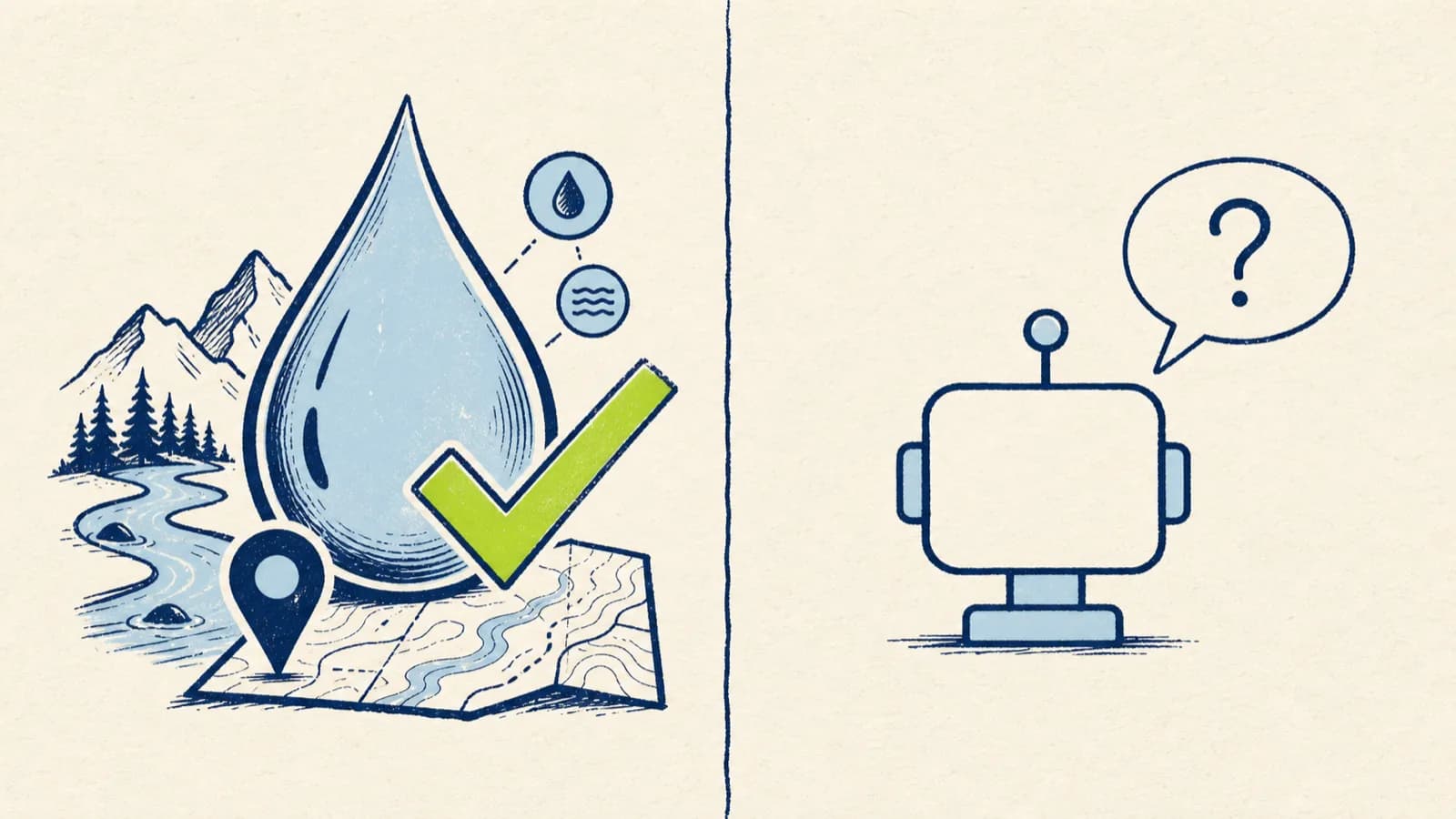
For a water dealer, an invented contaminant level or a made-up NSF certification isn't a small error — it's a claim you'd have to retract, in front of a homeowner deciding whether to trust your quote. The fix is grounding: a water specialist resolves every fact to an EPA limit, an NSF standard, or your catalog, and hands anything it can't source to a person. That's the line between an AI water specialist and a generic chatbot.
Where does Aqua Counsel fit?
Aqua Counsel is the website-first, water-specific option. It's the AI water specialist that greets a visitor, reads the contaminants in their ZIP from EPA data, recommends from your catalog, and books the in-home test — then hands complex cases to your specialist. For the phone, pair it with an answering service or missed-call text-back. Together they close both gaps.
Give your website a water specialist that answers, diagnoses, and books the test at 9 p.m. — see it live.
How should you choose?
- Losing most leads on the phone? Start with an answering service or missed-call text-back.
- Losing them on the website, after a search? An AI water specialist captures, diagnoses, and books.
- Want the water diagnosis and a catalog recommendation — not just a message? Only an AI water specialist does that.